What standard ecommerce speed tests miss is this: a store can be fast on the first product page and frustrating by the fifth. Client-side navigation, quick-view drawers, personalization, analytics listeners, and retained product media can accumulate work across a real shopping session.

Table of Contents
- Keyword decision and intent
- Why first-load testing misses the problem
- The long-session measurement model
- Common retention patterns
- Build a repeat-browse test
- Operator scenario
- A 45-day stabilization plan
- EcomToolkit point of view
Keyword decision and intent
- Primary keyword: ecommerce site performance statistics
- Secondary keywords: ecommerce memory leak, long-session performance, retained DOM ecommerce, INP degradation
- Search intent: technical diagnosis with commercial context
- Funnel stage: mid-funnel
- Page type: performance playbook
- Why this angle can win: current ecommerce performance pages focus on cold page load and Core Web Vitals; fewer test how a catalog journey behaves after repeated navigation and component use.
Field interaction data is central. web.dev’s guidance on finding slow interactions explains how INP attribution and Long Animation Frames can identify problematic real-user actions. The ecommerce extension is to add session depth and prior actions to that attribution.
Why first-load testing misses the problem
A synthetic test usually opens a fresh page in a clean browser context. Shoppers do not behave that way. They search, filter, open product drawers, switch variants, return to collections, compare delivery information, and revisit items.
In client-rendered experiences, previous UI state may remain reachable even after it is no longer visible. Event listeners can multiply. Observers can continue watching removed elements. Image galleries can retain decoded media. Analytics integrations can attach handlers on every route change. None of these problems needs to crash the page to harm conversion.
The visible symptoms are gradual:
- add-to-cart feedback becomes slower
- drawers stutter after repeated opening
- filters pause before updating the grid
- back navigation loses responsiveness
- the browser discards the tab on memory-constrained devices
- battery and CPU usage rise during ordinary browsing
The long-session measurement model
| Metric | Segment | Risk signal |
|---|---|---|
| INP by session page depth | 1-2, 3-5, 6+ views | interaction latency rises with depth |
| long animation frames per action | filter, drawer, variant, add to cart | repeated use creates more blocking work |
| live DOM growth | after each route/action cycle | nodes do not return toward baseline |
| listener/observer growth | component mount and unmount count | handlers multiply across navigation |
| JS heap trend | controlled lab journey | memory remains elevated after cleanup opportunity |
| tab discard/crash rate | device-memory tier | constrained devices fail disproportionately |
| conversion by session depth and latency | journey cohort | high-intent exploration loses yield |
Memory measurement can be browser-specific and sensitive. Use it in controlled profiling, then validate shopper impact through field interactions, errors, and session outcomes. Do not collect sensitive page contents or create heavy telemetry that worsens the problem.
Common retention patterns
Route transitions without teardown
Single-page applications and transition libraries can mount a new view while old subscriptions, timers, or listeners remain. Require every component with side effects to define cleanup behaviour.
Quick-view and recommendation loops
Drawers often create galleries, variant selectors, reviews, and tracking callbacks. Reopening the same interface should not create a fresh permanent set of observers.
Product media
High-resolution images and video can remain decoded after the viewer closes. Load media according to intent, release references when components unmount, and avoid preloading an entire catalog journey.
Third-party scripts
Consent, experimentation, personalization, chat, and analytics tools may not understand client-side lifecycle boundaries. Test them after repeated route changes, not only on initial load.
Unbounded client caches
Caching improves repeat access until it has no eviction policy. Bound caches by entry count, age, and commercial need; avoid storing complete responses when a smaller normalized record works.

Build a repeat-browse test
Create one scripted journey that reflects real consideration:
- land on a collection from a campaign
- apply and remove two filters
- open three product quick views
- visit five PDPs and change variants
- return to the collection after each PDP
- open cart, edit quantity, and continue shopping
- repeat one drawer and filter action
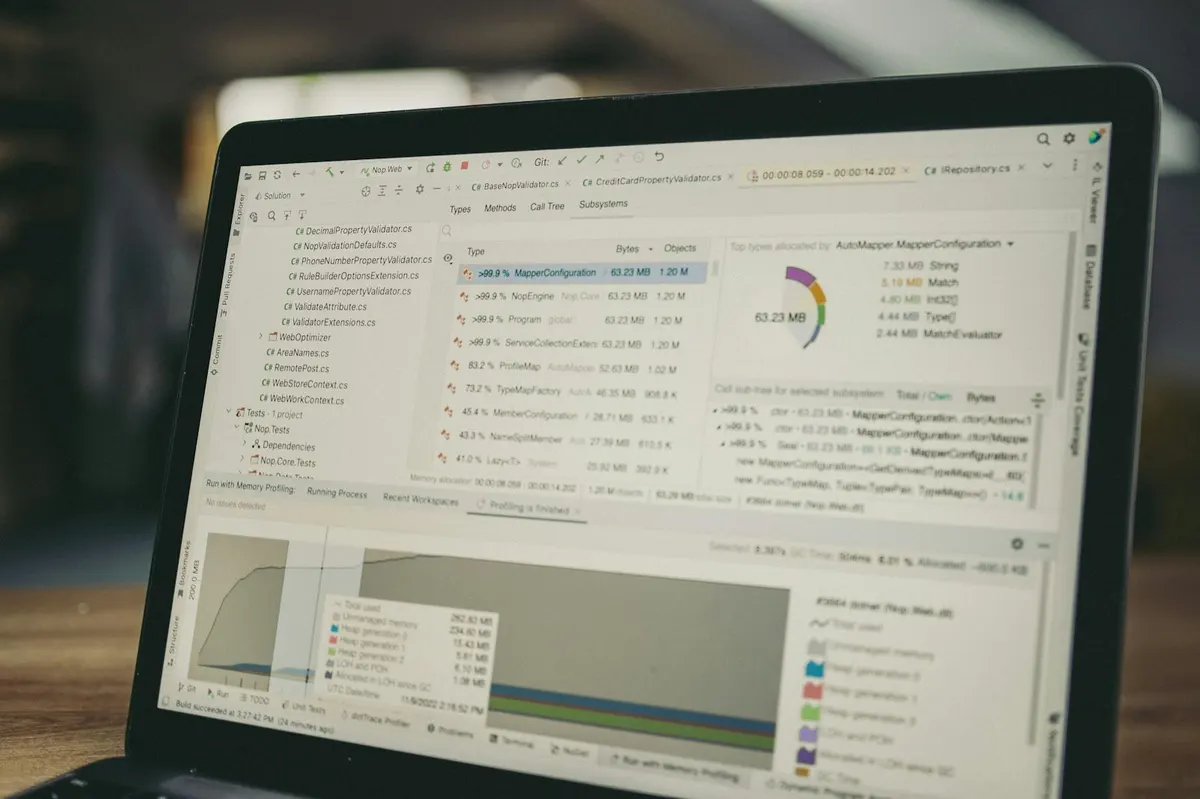
Record interaction traces and DOM/heap snapshots at the start, midpoint, and end. Compare a hard navigation baseline with the client-side journey. Run on a mid-tier mobile profile as well as desktop.
| Check | Pass evidence | Failure pattern |
|---|---|---|
| teardown | listener and observer counts stabilize | counts rise every cycle |
| DOM recovery | removed UI releases most nodes | detached subtrees accumulate |
| interaction | repeated action remains consistent | fifth action is slower than first |
| media | hidden viewers release unnecessary assets | decoded media grows continuously |
| cache | entries respect a documented bound | product data grows for whole session |
Use JavaScript and third-party governance to assign owners to scripts discovered in the trace.
Operator scenario
Consider a product-discovery experience that passes fresh-page tests. Customer sessions with six or more product views show worse add-to-cart responsiveness. A repeat-browse trace reveals that the quick-view component adds a resize observer and analytics listener every time it opens, while prior gallery media remains referenced.
The team fixes teardown, reuses one drawer instance, bounds its product cache, and adds the repeat-browse script to release validation. Success is measured through stable repeated-action traces and a narrower INP gap between early and deep sessions—not a one-off improvement on the homepage.
Open EcomToolkit resources to add long-session checks to the same performance operating model used for cold-load budgets.
A 45-day stabilization plan
| Period | Work | Exit condition |
|---|---|---|
| Days 1-10 | add session-depth and interaction attribution | field dashboard separates early and deep sessions |
| Days 11-20 | profile representative repeat journeys | retained components have named owners |
| Days 21-30 | fix teardown, media release, and cache bounds | repeated cycles approach a stable baseline |
| Days 31-38 | test third-party lifecycle behaviour | route changes do not multiply callbacks |
| Days 39-45 | gate releases with repeat-browse tests | regression fails before production |
Pair this with the ecommerce customer-journey latency analysis so technical depth is interpreted alongside commercial intent.
EcomToolkit point of view
Ecommerce performance is a session property, not only a page property. Stores that encourage exploration must remain responsive after the shopper has done the exploring.
Keep the cold-load test, but add a repeat-browse budget for DOM recovery, lifecycle cleanup, bounded caches, and interaction stability. Explore EcomToolkit resources to turn the test into a release control.